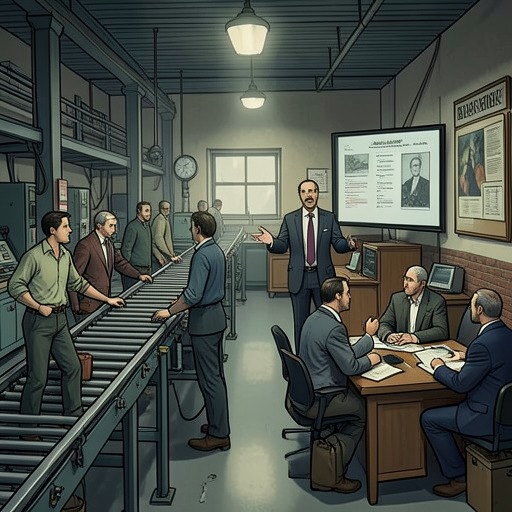
Corporate hierarchy
The Wisdom of CrowdsCorporate hierarchy is a system for arranging authority through successive levels of management, typically sending difficult or consequential problems upward and decisions back down. In the twentieth-century corporation, it helped organize large enterprises, but when combined with centralized power and too many layers it could distort information, suppress initiative, and leave senior executives remote from operational reality. The alternative is not simply to abolish structure: the challenge is to distribute decisions toward people with local knowledge while ensuring that their information can still be shared and used collectively.
Structure and Concentrated Authority
For much of the twentieth century, the prevailing model of the corporation combined vertical integration, hierarchy, and centralization. A company was expected to control as much of its supply chain as it could; managers at each level supervised those below them; and problems deemed too difficult or consequential were passed up the chain to people assumed to be more skilled. The structure promised a route from local action to higher-level judgment, but it also made rank a filter through which both questions and answers had to travel.
Centralization did not mean that headquarters directed every daily operation. General Motors, whose structure helped set the pattern for the modern corporation, took pride in giving Buick, Chevrolet, and Cadillac divisions day-to-day independence. Yet decisions shaping the company’s strategy and internal organization remained at headquarters, and final authority was concentrated in a small number of people, often the chief executive. The distinction matters: operational autonomy within divisions could coexist with a hierarchy that reserved consequential decisions for the center.
Companies also repeatedly praised employee empowerment and collective decision-making without necessarily transferring real decision rights. In the 1950s, enthusiasm for teamwork and committee meetings flourished even as William H. Whyte criticized corporations for idealizing middle managers and committees. The search for consensus could substitute for genuine participation: rather than expose competing judgments, familiar groups might favor safe, lowest-common-denominator solutions. Inclusiveness in discussion was not the same as distributing authority.
How Layers Distort Decisions
As decisions moved through more levels, committees could dilute them instead of improving them. At General Motors, even the relatively straightforward design of a new headlight was considered in fifteen meetings, with the chief executive attending the last five. The sequence made decision-making appear broadly consultative, yet the repeated review helped insulate senior leaders from unfiltered opinions and made the process increasingly cumbersome.
The same structure weakened responsibility. Managers could approve a subordinate’s advice and pass it upward, while subordinates assumed that their boss would check whatever was forwarded. When power was not truly delegated, lower-level employees had little reason to take initiative. The result was not simply delay: the organization risked losing the knowledge and judgment of people closest to the work.
A factory-floor episode from a General Motors plant in Van Nuys, California, shows how far operational knowledge could fail to travel. Two assembly-line workers repeatedly missed installing a bracket that held a car’s sunshade. When the omission was explained, one worker learned that the bracket served that purpose—after doing the job for two years. The example makes the informational cost concrete: workers could perform a task without being told how it related to the finished product, while the larger organization forfeited their ability to understand and improve the process.
The barriers extended beyond the shop floor. A chart reprinted in In Search of Excellence from an unnamed company mapped 223 different routes a new-product idea might take through its bureaucracy before acceptance. With so many layers between executives and workers in the field, senior leaders could not easily know whether their picture of the company matched its actual conditions. Studies of executives likewise found that career concerns could discourage the communication of problems: young executives who were more anxious to advance communicated problem-related information less accurately, and successful managers were associated with withholding reports of fights and budget difficulties.
Coordination, Information, and Local Knowledge
Hierarchy can coordinate activity through orders, but command-and-control management imposes costs. It takes time, requires top executives to handle information they should not need to process themselves, and can drain initiative from managers and workers. By the 1970s, American companies were losing some of their capacity to coordinate effectively despite their formal authority. At Ford, more than fifteen managerial layers separated the chairman from a factory-floor supervisor; at Toyota, the comparable number was five. The contrast suggests that coordination need not depend on stacking authority above the people doing the work.
The value of decentralization rests partly on local and tacit knowledge: information acquired through a particular job or experience that is difficult to summarize and transmit. Decisions about local problems are often better made by people close to them, whose practical understanding can exceed the managerial expertise of someone farther up the chain. In the account’s broader argument, decentralization encourages specialization and independent judgment, but it does not guarantee that useful information discovered in one part of an organization will reach the rest. Local knowledge has value only if the organization can also make it collectively usable.
This is why the problem is not solved by choosing either hierarchy or decentralization in the abstract. A corporation needs to preserve the specialization and independence that generate information while building ways to circulate and combine it. An organization with many layers can obstruct that flow; a decentralized organization without aggregation can leave separate pockets of knowledge disconnected. The central design question is how to link local understanding without making every judgment pass through a single authority.
Decentralizing Real Decisions
Genuine decentralization remains unusual despite its frequent appearance in corporate rhetoric. Blasi and Kruse estimated that fewer than 2 percent of American companies made real use of what they called high-performance work systems. Yet research on successful companies found employees and managers empowered to make more independent decisions and encouraged to look for improvements, including in their own operations. The gap between rhetoric and practice is therefore structural: praising initiative does not grant people the authority or channels needed to act on what they know.
Giving people control over their immediate working conditions can matter even when they do not use it directly. In a study, two groups worked on puzzles and proofreading amid loud, random noise. One group had a button that could turn the sound off; the other did not. Members of the group with the button never pressed it, but they solved five times as many puzzles and made fewer proofreading errors. The account uses the result to show how the availability of control can change performance, without requiring constant intervention from above.
Toyota’s production system presents a more direct organizational example. Frontline workers are trained in a wide range of skills and expected to understand the production process from the bottom up. Rather than isolate workers at single tasks along a classic assembly line, Toyota organizes them into teams that have greater responsibility for their own production process. Any worker can pull a cord to stop the line when something needs fixing; as with the experimental button, the cord is rarely pulled, but its availability is part of the system. Such arrangements allow workers to identify problems and coordinate improvements without relying on continuous orders and supervision.
Decentralization is thus not a claim that hierarchy can simply disappear, or that every local decision is necessarily correct. Its significance lies in distributing meaningful responsibility to the people with relevant knowledge, while reducing the informational bottlenecks created by excessive layers. Corporate hierarchy can support coordination, but when authority is concentrated and information is filtered on its way upward, the organization may become less informed than the people who compose it.